Bernoulli had a lot of time on his hands (another reason why I know he wasn't a mom), or at least enough time to develop theories and equations to describe fluid flow. To sum his findings up quickly, Bernoulli's equation states that as the speed of a fluid flow increases, its pressure decreases. And in related news, as the area that a fluid flows through decreases, its speed increases.
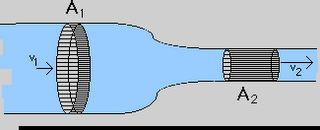
Why did I have to know all of this? Because my field of study happened to be aeronautical engineering, and because the Wright Brothers were the first ones that tried applying Bernoulli's Principle to predict lift on an airplane wing. (As you might have heard, they were successful!) So anyway, Bernoulli and his equation quickly became one of the cornerstones of my studies.
How does Bernoulli's equation help explain how those huge 747's stay in the air? It goes something like this:
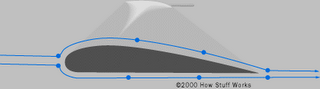
Most wings on airplanes are designed so that the top of the wings are curved, and the bottom of the wings are essentially flat. As air splits around a wing, the air flowing over the upper curved surface of an aircraft wing moves faster than the air beneath the wing, so that the pressure underneath is greater than that on the top of the wing. This pressure difference results in a force called lift, that then pushes the wing upward.
Now the truth of the matter is, that Bernoulli's equations alone doesn't completely explain how a plane flies. There is actually no one equation that is going to simply explain it, because it's not a simple phenomenon. Another guy you may have heard of, Isaac Newton, appeared to have lots of time on his hands as well (again, clearly not a mom). And he came up with additional equations and even LAWS that play a part in explaining how we now have the option of flying to Disneyworld in a matter of hours, as opposed to having to drive there over several days in a minivan with the kids in the back whining, "Are we there yet?" (THANK YOU, Mr. Bernoulli, and Mr. Newton!).
But even though using Bernoulli and his equation to explain airflight oversimplifies things a tad, you can still be a hero to your kids the next time they ask, "How do planes fly?", and you can have a scientifically substantiated answer ready for them. And if that's not enough, if one of your children wants to learn how to throw a curveball someday, Bernoulli can definitely help you there.
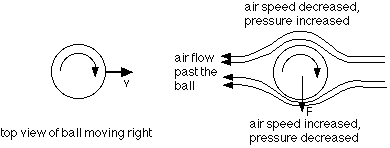
The key to throwing a curveball, is to throw it so it spins while its traveling forward. Not spinning end-over-end, like it's rolling through the air... but spinning around its middle, like a mini flying merry-go-round.
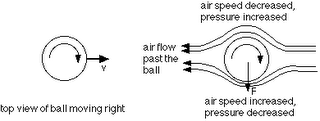
As air flows around the ball, the spin of the ball cause the air to slow down a little on one side and speed up a little on the other. The side where the air speed is higher has lower pressure, so the ball veers in the direction of the lower pressure and curves as it flies towards home plate.
Now, I can explain the science behind a curveball, but that doesn't mean I can throw one. I'm hoping that when my boys get bigger, they'll take after their dad in terms of athletic prowess. If they're interested in the mechanics behind it all, I'll be happy to chat it over with them. But in the meantime, I can entertain them by making a mean paper airplane.


No comments:
Post a Comment