Monday, January 01, 2007

The Scientific Method (Science)

Ahhh... a new year. A fresh start. A clean slate! There's nothing like New Year's Day, and having an entire limitless year stretched out before you. Of course that feeling is fleeting, because like all moms, I immediately start thinking of all the things that need to be accomplished during the next twelve months. Suddenly, I'm not sure how it will all get squeezed in.

What I need is a plan. Some kind of method to the madness. Luckily for me, those enterprising scientists came up with just such a method that can be applied to problems and challenges of all sorts! That's right, "The Scientific Method."

Now, this particular method may not have been invented for the purpose of tackling problems of childrearing and motherhood -- but that hasn't stopped it from working quite well in that environment. But what exactly is The Scientific Method?

In short, The Scientific Method is a means to investigate observations and solve problems. When facing a question of some sort, it is a systematic approach to develop an explanation or solution, and then determine if that explanation or solution is correct. It is comprised of six steps which are designed to get at the truth, regardless of what you think or may want the solution to be. That's pure science!

The steps are:

1. Define the problem or observation.
2. Gather information.
3. Form a hypothesis, or possible solution to the problem or explanation for the observation.
4. Use the hypothesis to make predictions.
5. Test those predictions by conducting an experiment or making futher observations, and modify the hypothesis as needed based on your results
6. Repeat steps 3-5 until there are no discrepancies between the hypothesis and the results of the experiment and/or observation.

Forming a hypothesis? Performing experiments? Surely moms are too busy to use this complicated method! Actually, we use it all the time without realizing it. Here's an example that may have even taken place in your house today:

All is peaceful in your household, and then suddenly your sweet and adorable baby that was so contentedly playing with his feet mere minutes before, begins to cry.

1. Define the problem: Junior is unhappy! He needs something... but what?

2. Gather information: A quick scan confirms that Junior doesn't have a bump or bruise, so it doesn't appear he has hurt himself. Your eyes flick to the clock and you quickly calculate that it's been about two hours since he's woken up and been changed, and about an hour since he's eaten.

3. Form a hypothesis: Two hours since a diaper change! He must be wet or dirty and that's why he's crying.

4. Make a prediction: If you change his diaper, he'll be a happy little boy again!

5. Test the prediction: You take him to the changing table, strip him down to his nappy... but he's perfectly clean and dry! So that's not the problem. What else could it be?

3. Modify the hypothesis: Junior has quite an appetite. He's hungry again, and that's why he's crying.

4. Make a new prediction: If you feed him a bottle, he'll be a happy little boy again!

5. Test the prediction: You bring him a bottle, and he grabs it hungerly from you. He sucks it down in record time, and rewards you with a happy and contented burb.

6. Results support hypothesis: You were right! Junior was hungry. Look at you, juggling motherhood and advanced scientific concepts at the same time!

Thursday, August 24, 2006

Blame it on Entropy (Science)

Entropy gets a bad rap. It's honestly a fairly straight-forward kind of thing... not too difficult to understand, and examples of it can be observed all around us in our every day life. But it's kind of got a bad reputation, and always seems to be at the center of discussions of uncertainty and chaos. It even seems to have it's hand in the whole global warming issue, for goodness sake!

I was first introduced to entropy in my junior year at Cal Poly, in my aerothermodynamics class. (Five days a week, 7 a.m. -- not a fun year.) Despite the early hour, I actually learned a lot from that course. Granted, that was in large part because I was scared to death of my professor, and didn't want to have to repeat this torture again in a "junior year redux". But regardless, the stuff stuck with me, including today's topic: entropy.

In simplest terms, entropy has to do with the tendency of the pressure, temperature, and density differences within a defined environment to equalize over time. The entropy of the defined environment, or "thermodynamic system", is a measure of how far the equalization has progressed.

Doesn't sound so simple? That's okay, I've come armed with an example.

Let's say, that on a hot summer day, you pour yourself a big glass of ice water. Now, being a mom, you'll never actually have a chance to take a sip of this water before some chaos will erupt in another room and you will have to go investigate. In the process of settling whatever dispute required your attention, you will remember that you have a wet load of laundry sitting in the washer that needs to be attended to. When you go to move the wet items into the dryer, you will discover that there is still a load of towels in there which now need to be folded and put away. While putting the clean towels away in the bathroom, you will notice that there is no longer any toilet paper on the roll and no spares under the sink. So you will go to the closet to get some more, and realize that you are almost out. Before this key point is forgotten, you will run to your desk to start a list of things you need from the store. But on the desk you will see the telephone bill that needs to get out in the mail today. After writing the check however, you will be dismayed to discover you are out of stamps. So before it gets any later, you gather the kids, outfit them in the necessary sneakers and sweaters, and take the whole brood to the post office.

By the time you get back from all of this, or whatever version of "If You Give a Mouse a Cookie" that your life resembles, you discover that your refreshing glass of ice water has now warmed to an unappealing room temperature.

So where does entropy fit in?

Well, while you were busy attending to the never-ending demands of the career we call motherhood... the heat energy that exists in the closed environment of your house, began spreading to the newly-introduced element inside of it, the ice water. When left alone long enough, the temperature of both equalized. Entropy is simply the yardstick that is used to measure this change that took place between the time when you poured the water, and when you returned back from the post office.

To make this official and scientific-like, the equation used to calculate entropy is dS=dQ/T.
Where for this situation:
dS is the change in entropy during the defined time period,
dQ is the heat exchanged between the warm house and cold ice water during this same period,
and T is the starting temperature (in degrees Kelvin) when you first poured the water.
For this case, the controlled enviornment that we are going to determine the entropy of will be the inside of your house, which contains the ice water and the air that surrounds it.

In our above ice water example, there are actually two elements in which we would need to measure: the ice water, and the air in your house surrounding the ice water. We would then add the changes that occured in both together to get the "total" entropy. Because, in addition to the water warming up, the air in the surrounding house actually cooled after the ice water was introduced... even if it was an imperceptable amount.

If you look at the two elements separately; in the case of the ice water, dQ would be the heat required to melt the ice and warm the water to room temperature, and T would be the starting temperature of the water which is 32 degrees F, or 273 degrees Kelvin (K).

In the surrounding house, dQ would be the amount the house cooled after you poured the ice water (which let's all agree, would be significantly less than a smidge), and T would be the starting temperature of the house, which let's assume would be 77 degrees F, or 298 K.

When you add the two together, the positive increase in heat energy used to warm up the water, far outweighs the negative heat lost with the slight cooling of the air, so the overall entropy for the controlled environment, or "thermodynamic system" of your house is positive -- or in other words, the entropy increased.

The interesting thing about entropy as a matter of fact, and the reason I still remember it from school, is that entropy always increases. In fact, that is such an absolute truth, that it is actually the Second Law of Thermodynamics: "The entropy of an isolated system not at equilibrium will tend to increase over time, approaching a maximum value."

(Some consider our entire universe to be an "isolated system" of it's own. As such, it may be subject to the Second Law of Thermodynamics, so that its total entropy is constantly increasing. Some even warn that the universe is fated to eventually reach a "heat death", in which all of the available energy ends up being distributed equally throughout the universe as thermal energy, so that no more work can be extracted from any source. But as I understand it, Al Gore is looking into all of this, so we should be okay.)

It is this "ever increasing" characteristic of entropy that has begun to give it a bit of a bad reputation. Because beyond this strictly thermodynamic definition, the word "entropy" has been used to describe the general tendency of all "systems" to mix it up a bit. In fact, the statistical interpretation of entropy is explained as the amount of uncertainty of a system -- or in terms a mom can understand, how many potential ways the elements of the system can spread out all over the place and make a big mess. And because entropy can only increase, things can only get messier.

For example, a jar of marbles would have a greater entropy than let's say a chair. As many ways as a child can knock a chair about, it's nothing compared to what he or she could do with a jar of marbles. And by the same token, the entropy of a jar of marbles would be small compared to that of a 5 pound bag of sugar. So based on this perspective, entropy is often viewed as the probablity of chaos.

This is something that all mothers have been instictively been measuring since the beginning of time... we just didn't know there was a special name for it.

Blame it on Entropy (Motherhood)

So given the fact that there is actually a law out there that says that things are destined to spread out everywhere and make as big a homogeneous mess as possible, what's a mother to do?

The answer: controlled chaos. That's right. We know we can't avoid chaos altogether, but we can hobble it a bit, and make sure it only impacts our lives on our terms. And how exactly do we do that, you may ask? By a little approach I call, "consolidate and camouflage".

In our house for example, all the kids’ rooms are upstairs, but they spend 90% of their time downstairs. So as much as I would like to hide all their toys away in their rooms behind a closed door… it’s not practical. Plus, the boys share a room, and as soon as the little one goes down for a nap, the other will most certainly think of a toy he absolutely has to have that is in his room, which would of course result in his brother getting woken up if he went in to fetch it. Then we have a cranky baby without a nap… and we’re back to chaos.

Also, as much as I enjoy a good stair-stepper workout, after about the 27th time in the course of the day that I would have to run up and down the stairs to either find, retrieve or put away a toy… my kids would have to learn to play with popcicle sticks and cotton balls, and be happy about it. So for many reasons, most of the toys are where the kids are: downstairs in the family room.

Now, on an odd occasion, I like to be able to actually walk across the family room without permanently harming the bottom of my foot by stepping on a toy car or baby rattle. And on even rarer occasions, I might even have company over. You know, a play date for ME. So I need to have a way to store and stash toys away without the first floor of our house looking like a toy store, but still have everything accessible so the kids can get to things (as well as easily put them away!).

So starting with the consolidating part, I quickly fell in love with those big plastic storage bins that you can get just about anywhere. They come in all shapes and sizes, and all have lids (fantastic!). And for all of the big collections of stuff with lots of little pieces, they would just get assigned a bin, and the toys would be dumped right in. We use one for all of the boys’ Thomas train engines and track, another for all of the baby-safe toys, another for legos… and on and on. They get pulled out of the downstairs closet when it’s time to play, and within five minutes they can be used to put toys away and out of sight.

But we don’t have a ton of available closet space, so for other items, we use the camouflage technique. That’s right, put stuff right out there, but make it “blend in” with the décor. A great thing to use for this are a bunch of fabric lined baskets. We use several small ones to store cars, blocks, and small books, and then sit them next to each other on a bookshelf. The kids can just grab the basket with the toys they want to play with, and once again when it’s cleanup time, they just pile them all back in and put the basket back on the shelf. And for all the other leftover toys, we use a big woven trunk as a toy chest. It sits on one side of the room, and the kids drag out what toys they want. Before nap, and before bed, they cleanup and put everything back inside. And if you don't want to look at toys anymore, just close the lid and they're out of sight.

So take THAT, entropy. You may have laws of thermodynamics on your side, but we have simple but stylish storage solutions on ours.


Timeout for Tea

On those rare occasions I can keep Captain Chaos at bay, I looooove to sit down with a hot cup of tea. The opportunites don't come often, sadly. Children seem to have this inate ability to sense as soon as you've sat down with a hot cup of coffee or tea... and that is precisely when they will try to flush their teddy bear down the toilet, or suddenly exceed the maximum capacity of their diaper.

Sometimes I have to manufacture my opportunity. I fully admit that there are times that I take advantage of the fact that one of shows that my kids adore is about to come on (Kipper the Dog and Pingu are big favorites in our house), and that's when I start heating up the tea kettle. If I can get the tea brewed and ready in time to settle the little ones down to watch a show, then I have a glorious 10-15 minute break that I can sit down with a cup of tea.

I'm not a big adventurer in the whole world of tea. I'm pretty much an English Breakfast girl ( found it, liked it, stickin' with it). I know there are just buckets full of choices out there, but I'm happy to stay close to my favorite. But I do love a little something sweet to go along with it. And when I have the time, this is my most favorite tea-time treat to make and enjoy: Scottish Shortbread.

I don't know if it's actually Scottish, or if it even vaguely resembles traditional shortbread. But that's the name I was given when I asked for the recipe, and it's absolutely delicious... so I'm not changing a thing. If I'm wrong, than you can make it and call it anything you'd like... but I bet you'll love it anyway.

Scottish Shortbread

2 cups all-purpose flour
1/4 teaspoon baking powder
1/4 teaspoon salt
1/2 cup confectioners' sugar
1 cup softened butter
1 teaspoon vanilla extract
2 tablespoons coarse decorating sugar

Preheat oven to 350 degrees F.

Lightly grease (with butter) a round 9-inch cakepan, or shortbread pan.

In a large bowl, stir the softened 1 cup butter and vanilla until just blended and smooth. In a separate, medium bowl, whisk together the flour, baking powder, salt and confectioners' sugar. Add to butter mixture about a quarter at a time, and mix until a stiff dough forms. Spread dough evenly in greased pan, and prick in several places with a fork. Sprinkle the coarse decorating sugar evenly over dough. (You may use 2 tablespoons granulated sugar instead if you do not have the coarse sugar.)

Bake for 30 minutes, or until golden brown. Cut into 8 wedges while warm.

Monday, August 21, 2006

Bernoulli Helps Explain Things (Science)

Daniel Bernoulli was never a mom. He might have been a father, a fantastic one at that, I don't actually know. But that's not why I know of him. Bernoulli was a mathematician and scientist from the 1700's, and I was introduced to him during my fluid dynamics class in college.

Bernoulli had a lot of time on his hands (another reason why I know he wasn't a mom), or at least enough time to develop theories and equations to describe fluid flow. To sum his findings up quickly,
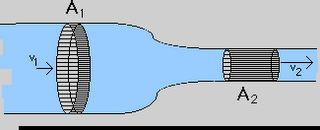
Bernoulli's equation states that as the speed of a fluid flow increases, its pressure decreases. And in related news, as the area that a fluid flows through decreases, its speed increases.


Why did I have to know all of this? Because my field of study happened to be aeronautical engineering, and because the Wright Brothers were the first ones that tried applying Bernoulli's Principle to predict lift on an airplane wing. (As you might have heard, they were successful!) So anyway, Bernoulli and his equation quickly became one of the cornerstones of my studies.

How does Bernoulli's equation help explain how those huge 747's stay in the air? It goes something like this:


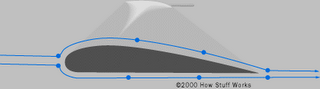
Most wings on airplanes are designed so that the top of the wings are curved, and the bottom of the wings are essentially flat. As air splits around a wing, the air flowing over the upper curved surface of an aircraft wing moves faster than the air beneath the wing, so that the pressure underneath is greater than that on the top of the wing. This pressure difference results in a force called lift, that then pushes the wing upward.

Now the truth of the matter is, that Bernoulli's equations alone doesn't completely explain how a plane flies. There is actually no one equation that is going to simply explain it, because it's not a simple phenomenon. Another guy you may have heard of, Isaac Newton, appeared to have lots of time on his hands as well (again, clearly not a mom). And he came up with additional equations and even LAWS that play a part in explaining how we now have the option of flying to Disneyworld in a matter of hours, as opposed to having to drive there over several days in a minivan with the kids in the back whining, "Are we there yet?" (THANK YOU, Mr. Bernoulli, and Mr. Newton!).

But even though using Bernoulli and his equation to explain airflight oversimplifies things a tad, you can still be a hero to your kids the next time they ask, "How do planes fly?", and you can have a scientifically substantiated answer ready for them. And if that's not enough, if one of your children wants to learn how to throw a curveball someday, Bernoulli can definitely help you there.

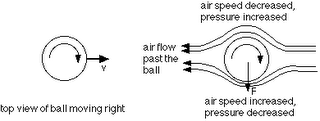
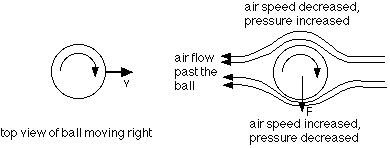
The key to throwing a curveball, is to throw it so it spins while its traveling forward. Not spinning end-over-end, like it's rolling through the air... but spinning around its middle, like a mini flying merry-go-round.


As air flows around the ball, the spin of the ball cause the air to slow down a little on one side and speed up a little on the other. The side where the air speed is higher has lower pressure, so the ball veers in the direction of the lower pressure and curves as it flies towards home plate.

Now, I can explain the science behind a curveball, but that doesn't mean I can throw one. I'm hoping that when my boys get bigger, they'll take after their dad in terms of athletic prowess. If they're interested in the mechanics behind it all, I'll be happy to chat it over with them. But in the meantime, I can entertain them by making a mean paper airplane.

Bernoulli Helps Explain Things (Motherhood)

Now, although the scientific community may not support me on this one, I've also found additional applications of Bernoulli's Principle that don't have anything to do with objects flying through the air, or fluid flowing through a pipe. I've discovered Bernoulli's well documented relationship between pressure and velocity comes in handy for more domestic issues.

Take for example, the timeless struggle at the dinner table. You've spent and hour or so creating a nutritious, delicious, well-balanced meal for your family. You've dished up a reasonable amount of everything on each plate, enough to cover the basic food groups, but not too much to overwhelm the smallish appetites of the younger ones. (Well, maybe your younger ones have smallish appetites. Truthfully, the two smallest members of our family can outeat most grown men... but I digress). But after all your hard work, and considerately-sized servings, it never fails that one member of the family will take offense to at least one of the lovingly homecooked dishes on his or her plate. (If the disagreeable one happens to be your husband, than that is simply an issue we will have to address on another day... but assuming the one giving you trouble is one of your children, continue on).

Throughout the meal, small amounts of encouragement may be given to this hold-out, in hopes that the progress will pick up a bit and that the meal will be finished. As the other plates on the table start to clear however, a more stern pressure may be applied, and flat out commands like, "Finish your peas!", may start to be issued. Eventually this usually escalates to something of the order of, "Finish your peas, or you can sit there all night for all I care!!" But by the time everyone else has completely finished their meals, even after secondary trips to the bread basket, it becomes clear that progress being made by this particular family member has stalled out completely.

So what would Bernoulli do? (WWBD?) Well, Mr. Bernoulli tells us: as pressure increases, speed decreases. This certainly seems to hold true in child/parent power struggles. The more insistent you are that the peas be eaten, the slower it seems the peas are actually consumed. So, what to do? Release the pressure. That's right, instead of burying the needle of the pressure gauge over in the red, just let up, and let it drop right off the scale. But along with it, also let go of the interaction that has been going on between you and the stubborn little monkey. Because, as most of us moms realize, it's never so much about the peas, as it is about the attention that is being paid to him or her because of the peas.

So it goes something like this: "Okay, you stubborn little monkey, (or you can use the child's actual name if you're from one of those polite families), take your time and finish your peas. But the rest of us have to move on to the next activity of the evening. When you're done with your peas, you can come join us!" And then, walk away.

Admittedly, the success of this approach relies heavily on the attractiveness of this other activity. Just as assumptions are made in the traditional application of Bernoulli's Principle (the flow is steady, the fluid has constant density, there is no friction, blah, blah, blah), assumptions are made here that the after-dinner activity isn't something horrid like a family trip to the doctor to get flu shots. But even if the next activity of the evening is cleaning the garage, it's eventually going to seem much more appealing to be out there with a broom and dustpan and the rest of the family, as opposed to sitting alone at the table with nothing but a handful of peas for company.

With the pressure released, you'll be surprised at how quickly the struggle can evaporate and the speed with which the meal can be finished. But just as Bernoulli alone may not explain how that plane gets in the air, this approach alone may not make every pea disappear... but it will most likely cut the struggle short, and make throwing a fit much less appealing next time.

Positive and Negative Uses for Ketchup

Not all of the domestic applications of Bernoulli's Principle are positive. Give any child a full squeeze bottle of ketchup, and he'll quickly figure out how Bernoulli operates all on his own. Give him a couple years, and he'll discover if he jumps on a fast food packet in the parking lot, he can spray ketchup several feet... and most likely all over mom's new spring skirt. As exciting as it may be to use these opportunities to help illustrate characteristics of fluid flow, and the relationships that Bernoulli discovered between pressure, area, and velocity... odds are that clean up duty will take priority.

So instead I will share with you my favorite all-time use for ketchup, and it doesn't involve Bernoulli or his Principle at all:

Magic Meatloaf Sauce

I think my sister first learned how to make this sauce in her Home Ec. class in junior high. Maybe it was high school, I don't exactly remember, but I know my sister was the source. She started stirring it up on the stove, and it looked average enough... but that night we put a bit on our meatloaf, and it was fantastic! My family flipped out over it, and we never had meatloaf without it again. My dad made sure she would make extra so he could use some on his meatloaf sandwich the next day. It's three simple ingredients, but don't underestimate it. It's yummy!

1/2 Cup Ketchup
1/2 Cup Brown Sugar
2 Tablespoons Prepared Mustard

Warm over medium/low heat until it just begins to bubble. Turn heat to low and let simmer for 5 minutes.

There are as many meatloaf recipes out there as there are moms, and I'm pretty sure this sauce will taste fantastic on all of them. (That's why it's magic!) But just in case you need a meatloaf recipe to go along with your sauce, here's a simple one I use at home. Serve with some mashed potatoes, peas, and a fresh green salad.

2 Pounds Ground Beef
1 Egg
1/4 Cup Seasoned Bread Crumbs
2 Tablespoons Worcestershire Sauce
2 Teaspoons Garlic Salt
1/2 Teaspoon Onion Powder

Heat oven to 350 F. Mix all ingredients thoroughly, and shape into a loaf approximately 8x4x2 inches. Place in an ungreased rectangular baking pan, 13x9x2 inches. Bake uncovered 1 hour.

Remove from oven, let cool for 10 minutes. Cut into 1-inch thick slices, and serve with a bit of Magic Meatloaf Sauce on top. Serves 6-8.

Thursday, August 17, 2006

Motherhood as a Career

First of all, I am being absolutely honest when I tell you that the three best days of my life were the days that my three children were born. Not to sell short the day that I met my husband, or my wedding day... but there is just nothing that compares to that moment when the doctor first hands you your newborn child, and you finally get to meet that little someone that you've been thinking about night and day since you peed on the stick and saw it turn pink (or blue, or red, or into a plus sign, or whichever sign of "Yes ma'am, you're pregnant" you received from your test of choice).

It's important that I get that right out there, way up front, because I adore my children, and absolutely love being a mother. But I don't think there is a mother out there that won't agree that having children changes your life completely. Your life is suddenly clearly defined into two periods that I like to refer to as B.C. and A.D. -- Before Children and After Delivery. What this designation lacks in originality, it makes up for in absolute, spot-on, polorized accuracy: there is what there was "before", and there is what there is "after".

"Before", I slept in on weekends. I mean, until I was not tired anymore. My body would actually have enough of lying there, doing nothing but resting and dreaming, and rouse itself. This fascinates me now. I literally have no memory of what that's like.

"After", I wake up every morning, somewhere around o'dark-thirty, to the sound of my 1-year-old torturing his 3-year-old brother and roommate, by quietly uttering "duh" over and over again. Why this particular phrase? I think he simply enjoys the soft sound it makes... and I know he enjoys how it makes his older brother absolutely crazy. It's not the babbling of the 1-year old that wakes me up, it is the top-of-the-lungs screaming of, "SSSSSSSSTOP IT!!!" from the 3-year old that actually gets me out of bed. I stumble to the boys' room to retrieve the baby from the wrath of his older brother, and with one more parting "DUH!", I take the little one downstairs while the 3-year-old whimpers in relief and collapses back on his pillow. Then, with the baby on my hip, I make a one-handed cup of coffee, and try to sip it while preventing the baby from batting it out of my hand. So begins my day. Sadly, the baby doesn't understand the concept of Saturday or Sunday morning, let alone the respect they so rightfully deserve, so this little morning show runs seven days a week.

"Before", I would read the Sunday paper. Everything. All of it. The news, the business section, real estate, sports (well, maybe only during football season. Go Broncos! ). Even that little "Parade" magazine, which happens to include one of my favorite articles of all time, "Ask Marilyn®". I always wanted to see if I could figure out the stumper of a brain teaser she would include each week. If I did, it somehow made my weekend that much sweeter.
(Want a taste? Try this one: "What change can be made to each of these words to produce new words: adds, ants, inks, ohms, sheer, star?")*

"After", I try to remember to salvage the advertising innards of the paper sometime between the time I've finished scrubbing the maple syrup off of the breakfast table, and sometime before my Dear Husband (DH) scatters the components of paper throughout the kitchen and family room like New Year's Eve confettii. My perusing of the Sunday paper has now become a harried snatch-and-grab operation in search of coupons for diapers, baby wipes, and apple juice. As for Marilyn, I hope she never asks me what becomes of her article most weekends in our house. It just happens that "Parade" magazine is approximately the same dimensions of the bottom of my daughter's hampster cage.

And most dramatically, and more to the point of why I'm babbling here in the first place; "Before", I was a career woman. I went to college, got an engineering degree from
Cal Poly in San Luis Obispo, California, and spent over 12 years in the corporate world. I did everything from product development, to strategic planning, sales and marketing, and even managed a multi-million dollar business segment for a corporation that consistantly sits in the top ten of the Fortune 500. I mean, I did stuff! I'm not saying I did anything exceptional, anything more than everyone else that's out there in the corporate world... I'm just saying that Before Children, I knew how to do a lot of stuff, and people actually paid me to apply what I knew to their business.

Now, "After", motherhood is my career. I'm a full-time, stay-at-home mom. My days start early, and they go late. There are no lunch hours, no afternoon trips to Starbucks before the staff meeting, no expense reports or business trips. No raises, no titles, no private offices... no privacy for that matter. It's a whole different world. But as tiring and challenging as it often is, I've also never in my life woken up each morning (or been woken up), more excited and happy to "go to work". Even during the best days of the jobs that I loved, I never enjoyed myself, and my life, as much as I do now... being able to spend every day with my children and family.

But I think it's come at a price. I begun to notice over the last couple years, that some of my brian cells seem to be suffering from lack of exercise. It's not to say that I haven't learned anything new! My gosh, just off the top of my head I can: list the names and distinguishing characteristics of all of The Wiggles (not to mention all of their songs); identify and name all the engines of Thomas & Friends by paint color and number designation; effectively argue the pros and cons of both sides of the vicious Diaper Genie vs. Diaper Champ debate; and in 30 minutes or less, can whip together no less than 25 different recipes using little more than a cup of brown rice and a can of cream of mushroom soup. Truly, if they ever have a tournament for Trivial Pursuit -- The Mother's Edition, I would be hard to beat!

But at the same time, I can't seem to complete a sentence anymore without having to substitute at least one or two words with "what-cha-ma-call-it" or "thing-a-ma-jig". More and more often I find myself running upstairs to grab something, and then standing in the middle of the room with no memory as to what it was I was looking for. When I'm out with friends, if the subject turns to away from babies, toys, or potty training... I realize I don't have much to add. And it seems the only books, movies, or shows I've seen lately all star cartoon characters. And although I've memorized all the things in the great green room, and I know the way to Sesame Street... I can tell my brain is starting to turn to mush around the edges.

So in an effort to blow the dust off my brain cells a bit, I decided to review some of the subjects I took while I was in college. I'm hoping it will reawaken some of the sparks in the ol' gray matter! But this time, instead of looking at things from the perspective of an engineer, I'm going to look at them from the perspective of a mom. Because science is a universal language, and it can be observed and applied in all walks of life... including Motherhood.

So here you'll find a daily review of various scientific principles, explained in a way all mothers can relate to... as well as some creative ways it can be applied and observed in a mother's daily life. I can't promise that I won't also go off on some random tangent in the process... after all, I don't think mush brain is entirely reversible. But hey, something that gets the wheels turning, no matter which direction, is never a bad thing.

Enjoy!

*Answer: Replace each letter with the next letter in alphabetical order, and each word becomes a new word. (Example: adds = beet.)